https://www.europarl.europa.eu/doceo/document/P-9-2022-000303_EN.html
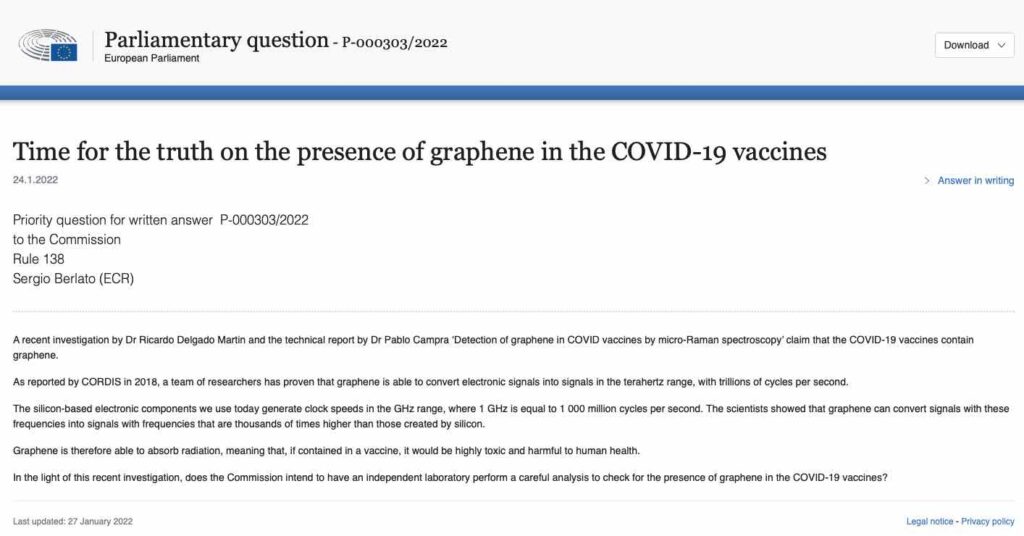
Time for the truth on the presence of graphene in the COVID-19 vaccines
24.1.2022
Priority question for written answer P-000303/2022
to the Commission
Rule 138
Sergio Berlato (ECR)
A recent investigation by Dr Ricardo Delgado Martin and the technical report by Dr Pablo Campra ‘Detection of graphene in COVID vaccines by micro-Raman spectroscopy’ claim that the COVID-19 vaccines contain graphene.
As reported by CORDIS in 2018, a team of researchers has proven that graphene is able to convert electronic signals into signals in the terahertz range, with trillions of cycles per second.
The silicon-based electronic components we use today generate clock speeds in the GHz range, where 1 GHz is equal to 1 000 million cycles per second. The scientists showed that graphene can convert signals with these frequencies into signals with frequencies that are thousands of times higher than those created by silicon.
Graphene is therefore able to absorb radiation, meaning that, if contained in a vaccine, it would be highly toxic and harmful to human health.
In the light of this recent investigation, does the Commission intend to have an independent laboratory perform a careful analysis to check for the presence of graphene in the COVID-19 vaccines?
Terahertz Meets AI : The State of the Art
by Arshad Farhad and Jae-Young Pyun
Department of Information and Communication, Engineering, Chosun University, Gwangju 61452, Republic of Korea
Submission received : 26 April 2023
Published : 24 May 2023
https://www.mdpi.com/1424-8220/23/11/5034
https://pubmed.ncbi.nlm.nih.gov/37299760/
- PMID: 37299760
- PMCID: PMC10255358
- DOI: 10.3390/s23115034
Abstract
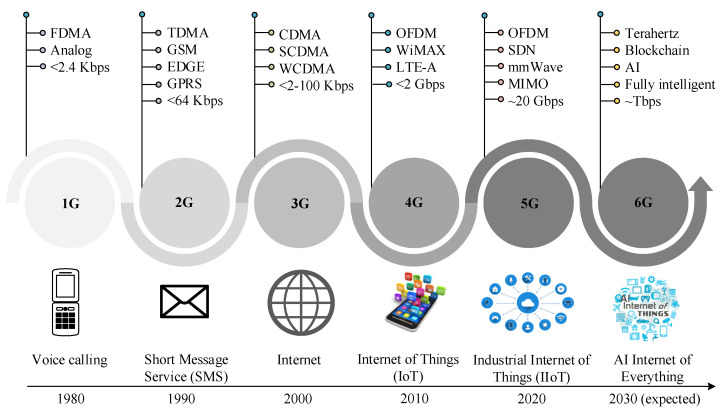
Terahertz (THz) is a promising technology for future wireless communication networks, particularly for 6G and beyond. The ultra-wide THz band, ranging from 0.1 to 10 THz, can potentially address the limited capacity and scarcity of spectrum in current wireless systems such as 4G-LTE and 5G. Furthermore, it is expected to support advanced wireless applications requiring high data transmission and quality services, i.e., terabit-per-second backhaul systems, ultra-high-definition streaming, virtual/augmented reality, and high-bandwidth wireless communications. In recent years, artificial intelligence (AI) has been used mainly for resource management, spectrum allocation, modulation and bandwidth classification, interference mitigation, beamforming, and medium access control layer protocols to improve THz performance. This survey paper examines the use of AI in state-of-the-art THz communications, discussing the challenges, potentials, and shortcomings. Additionally, this survey discusses the available platforms, including commercial, testbeds, and publicly available simulators for THz communications. Finally, this survey provides future strategies for improving the existing THz simulators and using AI methods, including deep learning, federated learning, and reinforcement learning, to improve THz communications.
Keywords: 6G; 6G and beyond; THz MAC protocols; THz simulators; Terahertz (THz); artificial intelligence (AI).
Graphene boosts GHz signals into Terahertz territory
https://cordis.europa.eu/article/id/124280-graphene-boosts-ghz-signals-into-terahertz-territory
Graphene – a one-atom-thick layer of hexagonally arranged carbon atoms – is the thinnest and strongest material known to man and an excellent conductor of heat and electricity. Since 2004, when researchers discovered how to extract it from graphite, graphene has opened new windows of opportunity in the world of science and technology. Over the past decade, scientists have predicted that its unique structure would make it especially efficient in converting optical or electronic signals into signals of much higher frequencies. However, all efforts to prove this were unsuccessful.
Now, for the first time, a team of researchers, two of whom are supported by the EU-funded project EUCALL, have proved that graphene is actually able to convert electronic signals into signals in the terahertz range, with trillions of cycles per second. The team’s findings are presented in a study(opens in new window) published in the journal ‘Nature’. Non-linear interaction The silicon-based electronic components used today generate clock speeds in the GHz range, where 1 GHz is equal to 1 000 million cycles per second. The scientists demonstrated that graphene can convert signals with these frequencies into signals with frequencies that are thousands of times higher than those created by silicon. What makes this feat possible is the highly efficient non-linear interaction between light and matter that occurs in graphene.
The researchers used graphene containing a large number of free electrons that originated from the interaction between graphene and the substrate onto which it was deposited. When these electrons became excited by an oscillating electric field in room-temperature conditions, they rapidly shared their energy with bound electrons in the material.
The electrons therefore reacted like a heated fluid, changing from liquid to vapour form inside the graphene within trillionths of a second. This transition led to powerful, rapid changes in the material’s conductivity, multiplying the frequency of the original GHz pulses. “We have now been able to provide the first direct proof of frequency multiplication from gigahertz to terahertz in a graphene monolayer and to generate electronic signals in the terahertz range with remarkable efficiency,” says co-author and Helmholtz Zentrum Dresden-Rossendorf (HZDR) senior scientist Dr Michael Gensch in a press release (opens in new window) posted on the project partner’s website.
High conversion efficiency The frequencies of the original electromagnetic pulses that were generated at HZDR’s TELBE terahertz facility ranged between 300 and 680 GHz. The scientists converted them into signals with three, five and seven times the initial frequency. “These conversion efficiencies are remarkably high, given that the electromagnetic interaction occurs in a single atomic layer,” the authors state in their study. The groundbreaking discovery supported by EUCALL (European Cluster of Advanced Laser Light Sources) makes graphene a promising candidate for the nanoelectronics of the future. For more information, please see: EUCALL project website(opens in new window)
‘Vaporized’ electrons in Graphene boost signals into the Terahertz range
Graphene and Derivates: Physico-Chemical and Toxicology Properties in the mRNA Vaccine
Manifacturing Strategy
Luisetto M1*, Almukthar N2, Tarro G3, Ahmadabadi NB4, Edbey KEK5,
Khan FA6, Hamid GA7, Fiazza C8, Cabianca L9, Ilman I10,
Rafa YA11, Rasool MG12, Prince GG13 and Yurevich O14
Article Type: Journal Type: Volume: 1 Manuscript ID: Publisher:
Recieved Date: 09 Aug 2022 Accepted Date: 19 Aug 2022 Published Date: 25 Aug 2022
1. Abstract
Aim of this work is to verify the state of the art related the use of graphene and its derivates in some vaccine technology (m RNA), to show the chemical properties of this kind of carriers (or extractive agent) and to list the evidence at today related peculiarity involved in some covid-19 vaccine. The researchers will produce their own opinion about this topic.
Of great relevance to verify the manifacturing procedure of this innovative product (mRna vaccine) and the technology and material used in purification phases.
9. Conclusion
Related the recent evidence, the profile of toxicicy of graphene products, the clinical aspects of some rare ADR of some covid-19 vaccine and the chemical physical properties of this carriers need to be deeply investigated.
The use in vaccine strategy started before covid-19 pandemia also related cancer vaccine but at today various project test, this material in an intranasal vaccine so it is possible to say that probably the Efficacy/ toxicity profile depend also on the way of sub-ministration.
Because this product, as reported in literature, increase some immune response it is interesting to continue the research to find the real pharmaceutical/ toxicological profile.
In every way it is fundamental to observe the manufacturing process, the technologies and material used to Produce and purify this mRNA vaccine: this can make possible to better understand the impurity profile even if this are not reported in the technical sheet of some approved mRna vaccine related the graphene and derivated presence.
source : https://www.sciencworldpublishing.org/science-world/articlepdf/swjps-v1-107.pdf
1 IMA Academy Marijnskaya, Professorship Toxicology, Pharmacology, Natural Science Branch, Italy
2 Profesor Physiology Babylon University, Iraq
3 President of the T & L de Beaumont Bonelli Foundation for Cancer Research, Naples, Italy
4 Nano Drug Delivery, (a Product Development Firm), United States
5 Professor, Department of Chemistry, Libya Physical Chemistry, University of Benghazi, Libya
6 Professor, Department of Pharmacology, Jawaharlal Nehru Medical College, AMU, Aligarh
7 Professor Hematology Oncology, University of Aden, Yemen
8 Independer Researcher, Medical Pharmacologist, Italy
9 Bio-Medical Laboratory Turin Italy Citta’ Della, Salute10Student, Dhaka Residential Model College, Dhaka, Bangladesh
11 University of Nebraska-Lincoln, NE, USA Majoring in Biological
12 Department of Medical & Health Sciences for Woman, Peoples University of Medical and Health Sciences for Women, Pakistan
13 Chair CYPRESS University, Malawi
14 Llatyshev IMA President, RU
Research Article
Open Access
Issue: 2
SWJPS-1-107
Science World Publishing
Article Information *Corresponding Author:Mauro Luisetto,IMA Academy Marijnskaya, Professorship Toxicology, Pharmacology, NaturalScience Branch, Italy,
E-mail: maurolu65@gmail.com
Citation:Luisetto M (2022).
Graphene and Derivates: Physico-Chemi- cal and Toxicology Properties in the mRNA Vaccine Manifacturing Strategy .
Sci World J Pharm Sci, 1(2);1-23
Copyright: © 2022, Luisetto M, et al., This is an open-access article distributed under the terms of the Creative Commons Attribution 4.0 international License, which permits unrestricted use, distribution and reproduction in any medium, provided the original author and source are credited.



