source : IEEE
Abstract:
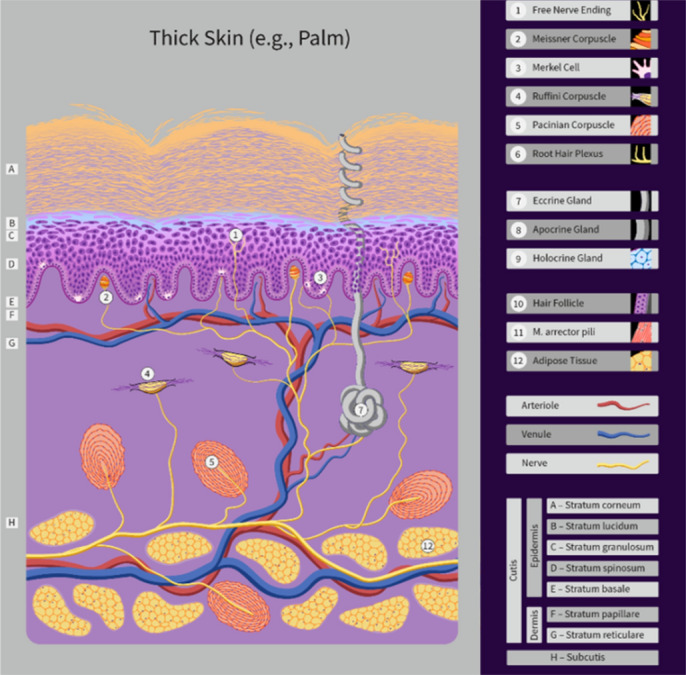
Figure 1. A schematic of human skin showing the main human skin layers and coiled sweat duct. (Modified from the original under a CC BY SA license, https://creativecommons.org/licenses/by-sa/4.0/. Copyright Guido Hegasy, https://www.hegasy.de/).
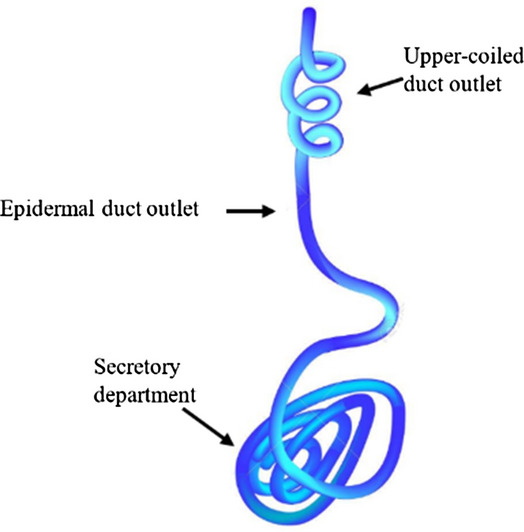
Figure 2 – Schematics of eccrine sweat gland.
Emission from human skin in the sub THz frequency band
Abstract
Recently published Radiometric measurements of human subjects in the frequency range 480–700 GHz, demonstrate the emission of blackbody radiation from the body core, rather than the skin surface. We present a detailed electromagnetic simulation of the dermis and epidermis, taking into account the presence of the sweat duct. This complex structure can be considered as an electromagnetic bio-metamaterial, whereby the layered structure, along with the topology of the sweat duct, reveals a complex interference pattern in the skin. The model is capable of accurately representing the skin greyness factor as a function of frequency and this is confirmed by radiometry of living human skin.
Introduction
Modern health care greatly benefits from non-invasive diagnostic techniques, especially if they are passive. Yet, there are surprisingly few methodologies for this. Beyond visual inspection, some work has been done on thermal imaging1,2, facial recognition3 and even using Doppler Radar4 to monitor heartbeat. However, the avenues for such monitoring are restricted by what can be emitted via human skin. Recently, Radiometry experiments on human subjects has revealed that in the sub-THz frequency band (480 GHz to 700 GHz) the emitted signal can reflect the level of stress experience by the person5. This work suggested the body core temperature as a source of blackbody radiation (T = 37 °C) that was modulated by its passage through the skin. To understand better the nature of transmission through the skin, one can use a simulation model. In this work, we perform analysis of electromagnetic (EM) response of the human skin in the frequency range of 500 GHz up to 700 GHz, by studying the simulated transmission coefficient, S21, in this frequency range. Using this approach, we clarify what part of the blackbody radiation passes the human skin to the outer world and what part of the skin, considered as a layered system with non-flat boundaries, is the dominant component in this mechanism. The simulation work is based on an EM human skin model that was developed in house6,7. The new model, optimized for the current analysis, contains the two sections of the sweat duct—the upper epidermal coiled outlet duct and the dermal duct outlet, which was previously ignored.
In the interaction of microwave radiation and human beings, the skin is traditionally considered as just an absorbing stratum sponge filled with water. In 2008 we demonstrated that such a view is inconsistent for the sub-THz band8. Human sweat gland ducts are coiled in the epidermis and, given their geometry, dimensions and electrical properties, could be regarded as EM entities9,10. We demonstrated that the sweat duct could have EM behaviours reminiscent of helical antennas. Experimental evidence was presented that the reflectance of the human skin in the sub-THz region strongly depends on the level of activity of the perspiration system6,7,11. Additionally, it correlates with physiological stress as manifested, e.g., by the Galvanic Skin Response (GSR), pulse rate and the systolic blood pressure12,13.
Recently, we modelled the human skin’s reflectance to an impinging sub-THz field using our model, based on the dimensions and dielectric parameters of the skin layers and structures like the sweat duct. Based on this model we have extracted the most suitable ac conductivity values of the sweat duct by fitting our simulation results to experimental values of reflection coefficient from human skin. An interesting outcome of this work is the recognition that future 5G transmissions will lead to standing wave absorptions in the skin, where the presence of the sweat duct will play a dominant role6,7,14. In the most recent work, a radiometric study of human emissivity around 500 GHz and 507 GHz was conducted on 32 volunteers. The experimental setup was based around a Superconducting Integrated Receiver (SIR)15. The SIR was used to measure the brightness temperature of subject’s skin at 500 and 507 GHz for the entire subject pool. Additionally, spectral measurements in the range 480–700 GHz were carried out on 3 subjects. Tuning the SIR for each frequency point is a time-consuming process. The results demonstrated the first evidence that human stress directly effects the emission of skin. In addition, the experiment suggested that the source of the emission was in fact blackbody radiation from the body core rather than the skin surface. To better understand this statement, one must investigate just how radiation in this frequency range passes through the skin and this can only be done by simulation. In the following sections we provide a brief scientific background of the structure of human skin. The human skin model is described and finally the simulation results, discussion and conclusions are presented.



